Email
WhatsApp

When a critical conveyor halts during peak production or a CNC spindle loses torque mid-cycle, the root cause often traces back to demagnetization in permanent magnet synchronous motors (PMSMs). For procurement managers and engineers sourcing industrial drives, understanding what causes demagnetization in permanent magnet synchronous motors and how to prevent it is a decisive factor in supplier qualification, total cost of ownership, and uninterrupted manufacturing. At Raydafon Technology Group Co.,Limited, we’ve dedicated over twenty years to engineering PMSM solutions that excel in demanding environments, so our clients never face unplanned downtime from magnet degradation. This guide uncovers the thermal, electrical, and mechanical mechanisms that erode magnetic performance, illustrates real factory-floor scenarios where demagnetization strikes without warning, and delivers proven prevention strategies—all grounded in material science and field data. By the end, you’ll have a clear technical roadmap to safeguard your motor investments and streamline vendor selection.
Table of Contents
Permanent magnet synchronous motors rely on high‑energy magnets, typically neodymium‑iron‑boron (NdFeB), to generate a rotor field with zero slip. Demagnetization occurs when the operating point drops below the knee of the magnet’s B‑H curve, causing an irreversible loss of flux. The three dominant triggers are excessive temperature, strong opposing magnetic fields, and physical degradation.
Thermal stress is the most common culprit. Every NdFeB grade has a maximum operating temperature; exceed it and the magnet’s coercivity plummets, sometimes permanently. In a poorly ventilated motor enclosure, winding heat can push magnet temperatures beyond 150°C within minutes. Equally destructive are demagnetizing armature reaction fields produced during sudden overloads or inverter mis‑tuning. When a VFD commands a high current at a low power factor, the stator field can directly oppose the rotor magnets, driving them into the irreversible quadrant. Mechanical damage—such as corrosion, micro‑cracks from vibration, or coating failure—further accelerates flux loss by exposing the magnet material to moisture and oxygen. Raydafon’s motor designs mitigate all three root causes by combining high‑coercivity grades, optimized slot geometry, and sealed housings from the outset.
Picture a high‑speed packaging line running 24/7 in a factory without climate control. As ambient temperatures rise above 45°C, the servo motor on the sealing jaw experiences frequent peak‑torque demands. The winding temperature soars, and the N35‑grade magnets—chosen for cost savings—begin to lose flux after only six months. Output torque drops, product sealing becomes inconsistent, and the entire line requires unscheduled maintenance. This scenario repeats across industries because procurement decisions often prioritize initial price over lifetime magnet integrity.
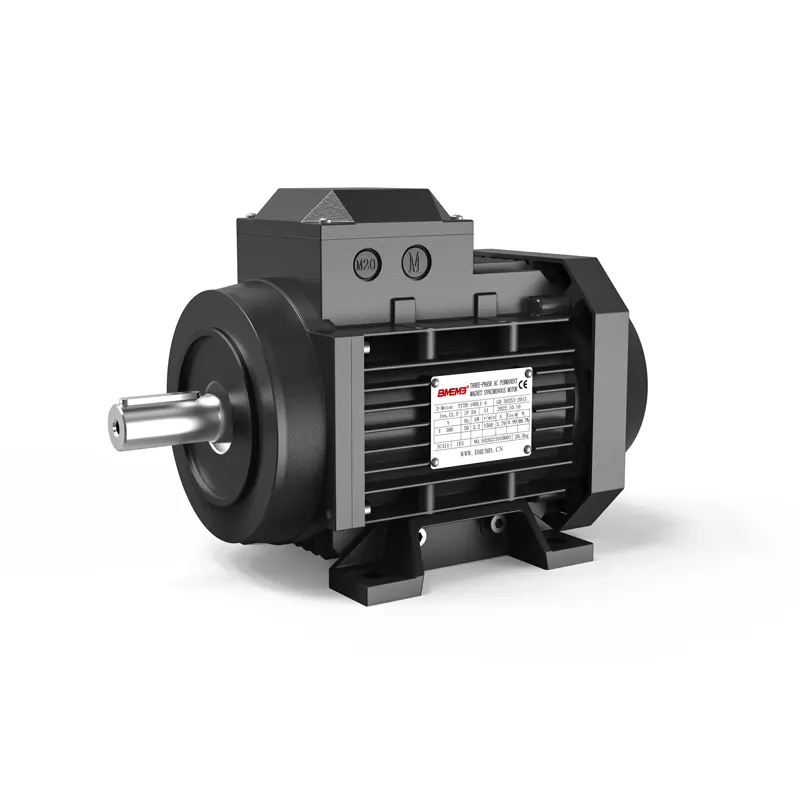
Another common case involves variable‑frequency drives with poorly configured current limits. An injection molding machine’s PMSM, rated for 180% overload for two seconds, receives a current spike of 220% during a mold‑stick event. The transient armature reaction creates a reverse field strong enough to partially demagnetize the rotor. Although the motor still runs, its efficiency and torque constant are permanently reduced, leading to higher energy bills and cycle times. Raydafon’s TYTB series motors integrate N42UH magnets and embedded temperature sensors that signal the drive to limit current before critical flux levels are approached.
In food processing plants subject to daily washdowns, moisture ingress through shaft seals causes magnet coating to blister and oxidize. Even minor oxidation creates surface pits that act as nucleation sites for irreversible domain wall pinning, reducing remanence. Raydafon addresses this with VPI insulation, IP67 sealing options, and stainless‑steel shafts, ensuring that corrosive agents never reach the magnet assembly.
Preventing demagnetization requires a multi‑layered approach that starts during motor specification and extends through drive programming and thermal management. The single most impactful decision is selecting the right magnet grade. Higher intrinsic coercivity (Hci) directly translates to greater resistance against both thermal and electrical demagnetization. The table below compares commonly available NdFeB grades used in industrial PMSMs.
| Magnet Grade | Max Operating Temp (°C) | Intrinsic Coercivity (kA/m) | Typical Application |
|---|---|---|---|
| N35 | 80 | ≥955 | Low‑cost, low‑temperature environments |
| N38SH | 150 | ≥1592 | General industrial servos |
| N42UH | 180 | ≥1990 | High‑temperature, high‑reliability (Raydafon standard) |
| N48EH | 200 | ≥2388 | Extreme duty, EV traction |
Beyond material choice, drive parameter settings form a critical defense. Implementing a current‑limiting algorithm that respects the motor’s demagnetization boundary prevents the stator MMF from reversing flux. Thermal protection is equally vital; embedding PTC thermistors or KTY sensors in the windings enables real‑time temperature monitoring that can trigger forced cooling or reduced current before magnet temperatures exceed safe limits. Mechanical robustness—including anti‑corrosion coatings, vibration‑dampened rotor assemblies, and controlled air gap tolerances—completes the protection scheme. Raydafon Technology Group Co.,Limited defaults to N42UH magnets and supplies matched servo drives pre‑configured with anti‑demagnetization tables, eliminating guesswork for procurement teams.
Q: What causes demagnetization in permanent magnet synchronous motors and how to prevent it in environments with frequent start‑stop cycles?
A: Frequent start‑stop cycles generate repetitive inrush currents that subject magnets to cyclic high‑temperature excursions and strong demagnetizing fields. To prevent cumulative degradation, specify magnets with high intrinsic coercivity (N42UH or higher), implement soft‑start ramp‑up profiles in the drive, and ensure sufficient thermal mass or forced convection cooling. Raydafon’s motor‑drive packages include adaptive current limiting that caps the stator field intensity during the first few electrical cycles, effectively preserving flux over millions of cycles.
Q: What causes demagnetization in permanent magnet synchronous motors and how to prevent it when operating in high‑humidity or chemically aggressive atmospheres?
A: Exposure to moisture, acids, or alkaline cleaning agents attacks the nickel‑copper‑nickel coating on sintered NdFeB magnets, leading to hydrogen embrittlement and surface oxidation that permanently reduce remanence. Prevention relies on superior sealing—IP66 or IP67 enclosures—combined with magnet encapsulation and corrosion‑resistant rotor cans. Raydafon’s TYTB series offers optional epoxy‑sealed stator cores and 316 stainless‑steel housings, validated by 1,000‑hour salt spray tests, making them suitable for food, pharmaceutical, and marine applications.
Selecting a motor supplier is a long‑term partnership decision. Raydafon Technology Group Co.,Limited embeds demagnetization prevention into every stage—from magnet procurement (sourcing certified N42UH and N48EH grades directly from mines) to stator winding insulation and final drive matching. Our application engineers collaborate with your team to analyze load profiles and recommend the optimal magnet grade, cooling method, and drive protection limits. The result is a PMSM that maintains its torque constant within 2% over a decade of continuous operation, protecting your production uptime and controlling life‑cycle costs. For a tailored anti‑demagnetization proposal, discuss your project specifications with us directly.
Raydafon Technology Group Co.,Limited is a vertically integrated manufacturer of permanent magnet synchronous motors and intelligent servo drives, headquartered in Changzhou, China, with distribution hubs across Europe, North America, and Southeast Asia. Since 2003, we have delivered over three million motors to OEMs in robotics, CNC machinery, packaging, textile, and renewable energy sectors. Our in‑house R&D center holds 47 patents related to thermal management, magnet retention, and real‑time demagnetization monitoring. Certified to ISO 9001:2015 and CE, Raydafon is the preferred partner of Fortune 500 companies seeking reliable, energy‑efficient motion control. For inquiries, sample requests, or technical datasheets, please contact our global sales team at [email protected] or visit https://www.raydafondrive.com.
Zhou, H., & Li, J., 2018. “Irreversible Demagnetization Analysis of NdFeB Magnets in PMSM Under Transient Thermal Conditions.” IEEE Transactions on Energy Conversion, 33(4).
Tanaka, S., 2020. “High‑Coercivity Sintered Nd‑Fe‑B Magnets for Electric Propulsion Motors.” Journal of the Japan Institute of Metals, 84(2).
Kim, D., Park, S., & Lee, K., 2019. “Demagnetization Fault Diagnosis of Interior Permanent Magnet Synchronous Motors Using Back‑EMF Harmonics.” IEEE Transactions on Industrial Electronics, 66(9).
Müller, R., & Chen, Y., 2021. “Temperature‑Dependent Demagnetization Modelling of PMSMs with Fractional Slot Concentrated Windings.” IET Electric Power Applications, 15(6).
Gieras, J., & Wing, M., 2017. “Magnet Materials and Thermal Limits in PM Brushless Motors.” IEEE Industry Applications Magazine, 23(3).
Huang, X., Goodman, R., & Zhu, Z., 2020. “Influence of Drive Cycle on Rotor Magnet Demagnetization in EV‑Traction PMSMs.” IEEE Transactions on Transportation Electrification, 6(2).
Nakamura, H., 2018. “Corrosion Protection of NdFeB Magnets for Harsh Environment Motors.” Materials Science and Engineering B, 228.
Li, W., Cheng, M., & Hua, W., 2019. “Online Monitoring of Permanent Magnet Demagnetization Using Search Coils.” IEEE Sensors Journal, 19(22).
Bianchi, N., & Fornasiero, E., 2016. “Impact of MMF Space Harmonic and Rotor Skew on Magnet Losses in PMSM.” IEEE Transactions on Industry Applications, 52(4).
Fischer, R., & Jokinen, T., 2022. “Design Rules for Demagnetization‑Proof PM Synchronous Machines in Battery‑Powered Tools.” Energies, 15(14).