Email
WhatsApp

Picture this: your assembly robot loses power for half a second, and the vertical axis begins to drift downward. The first question your maintenance team asks is: Can a Planetary Gearbox be backdriven? For procurement professionals sourcing gearboxes for conveyors, robotics, packaging lines, or rotary indexers, this is not just a technical curiosity—it is a safety, cycle-time, and cost issue. Backdriving means the output shaft can be rotated by an external load when the input is not powered. In many planetary units, low and medium ratios allow backdriving easily because efficiency is high. In high-ratio stages, friction and multiple gear meshes reduce reverse efficiency, so the unit may resist motion and act almost like a brake. The right answer depends on ratio, efficiency, friction, lubricant temperature, and holding torque. Choosing incorrectly can lead to sagging loads, positioning errors, or unexpected locking. At Raydafon Technology Group Co.,Limited, we help sourcing teams define the required backdrivability early, compare gearbox options with real data, and avoid costly field failures before they happen. In this guide, we explain exactly when a planetary gearbox can be backdriven, how to evaluate the threshold, and how to specify the safest, most cost-effective unit for your machine.
In a planetary gearbox, power normally flows from the input shaft through the sun gear to the planet gears, carrier, and output shaft. Backdriving is the reverse condition: an external load on the output side tries to rotate the output shaft while the motor is off or holding. This can happen in robotic arms, automated guided vehicles, vertical lifts, palletizers, and indexing tables. In low-ratio planetary stages, the output side can be turned by hand because the gear train is highly efficient. In higher-ratio or multi-stage units, friction across more gear meshes reduces the reverse efficiency, so a much larger external torque is needed to backdrive the unit. Some high-ratio planetary gearboxes may appear self-locking under light loads, but they are not certified safety brakes unless the supplier has tested them for that duty. Understanding this difference helps purchasing teams avoid two costly mistakes: specifying a gearbox that drifts under gravity, or paying extra for a high-ratio stage that blocks manual adjustment.
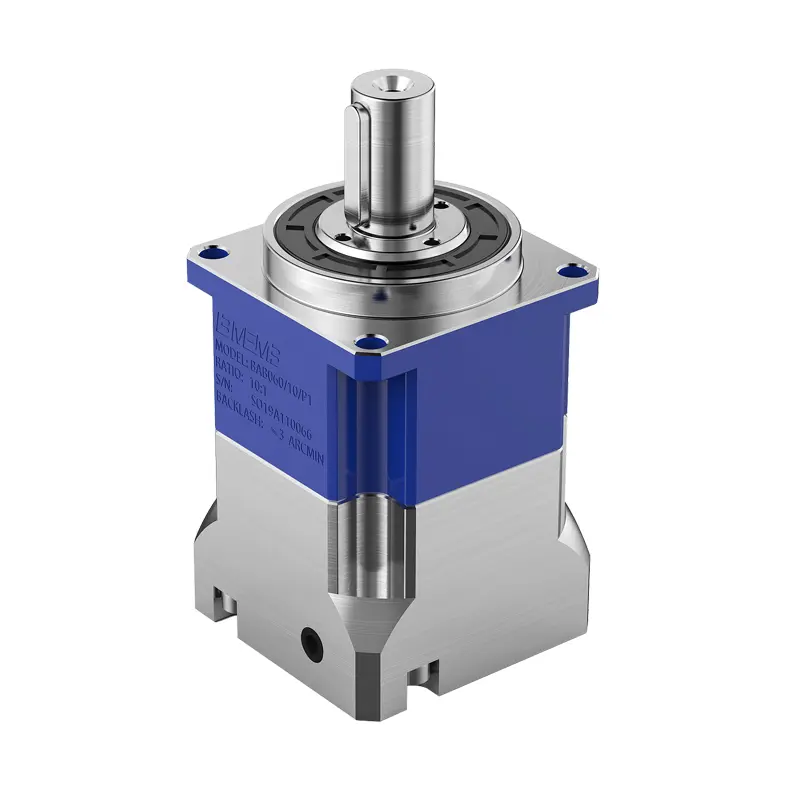
Before you compare quotes, it helps to know which design factors determine whether a planetary gearbox can be backdriven. The main variables are:
For a sourcing team, the practical lesson is simple: do not assume that all planetary gearboxes behave the same way. Ask the supplier for the reverse efficiency or backdrive torque at your specific ratio, load, and temperature. Raydafon Technology Group Co.,Limited provides these data during selection instead of leaving you to guess.
The table below gives a practical reference for standard planetary gearboxes. Use it as a starting point, but always confirm the exact values with your supplier because gear geometry, bearing preload, and lubrication can shift the results.
| Gear ratio | Typical forward efficiency | Backdriving behavior | Common application |
|---|---|---|---|
| 3:1 to 10:1 | 90% to 97% | Readily backdriven | Robotic joints, indexing tables |
| 10:1 to 30:1 | 80% to 90% | Backdriven with moderate torque | Conveyors, packaging axes |
| 30:1 to 100:1 | 70% to 80% | May require high reverse torque | Lifting, hoisting, vertical axes |
| Above 100:1 | Below 70% | Often self-locking in practice | Holding devices, manual positioning |
These values explain why a 5:1 planetary gearbox is often backdriven by hand, while a 100:1 unit may hold a light load without a brake. However, self-locking is not a guarantee unless the manufacturer has verified the specific load case. If your application cannot tolerate drift, specify a brake, a motor with holding torque, or a tested self-locking configuration.
Pain point: A purchasing engineer receives three quotes for a cartesian robot axis. The requested ratio is 20:1, but one supplier warns about backdriving, another ignores it, and the third adds a brake without explaining why. The buyer is left comparing prices instead of performance.
Solution: Start with a backdrivability checklist. Define the maximum output load, the required ratio, the duty cycle, and whether the axis must hold position at rest. Then ask each supplier for the reverse efficiency, backdrive torque, and recommended holding method. Raydafon Technology Group Co.,Limited uses this data to recommend a planetary gearbox that balances cost, backlash, efficiency, and holding safety.
| Parameter to specify | Why it matters | Raydafon support |
|---|---|---|
| Maximum output torque | Determines whether the load can backdrive the unit | Calculates backdrive torque for your axis |
| Gear ratio | Controls speed, torque, and reverse efficiency | Confirms suitable single- or multi-stage designs |
| Backlash | Affects positioning accuracy and reverse motion feel | Offers standard and low-backlash options |
| Holding requirement | Decides if a brake or self-locking stage is needed | Integrates brakes or motor holding torque |
| Operating temperature | Changes lubricant viscosity and friction | Recommends suitable grease and sealing |
This structured approach turns a confusing performance question into a simple supplier comparison. It also prevents the most common field issue: a machine axis that drifts after the motor stops.
Q: Can a planetary gearbox be backdriven if it is rated at 50:1?
A: It depends on the load and the exact efficiency of the unit. At 50:1, many planetary gearboxes still have enough reverse efficiency to be backdriven if the output torque is high. However, they will resist motion much more than a 5:1 unit. In vertical lifting applications, a 50:1 stage may hold a light load, but it is not a safety brake. Always calculate the backdrive torque or request a holding test from the supplier. Raydafon can verify this for your specific load and mounting orientation.
Q: Can a planetary gearbox be backdriven in a lifting application without a brake?
A: It can be, especially with low-ratio units, but it is risky. If the gearbox backdrives, the load may descend when the motor is off, creating a safety hazard. For any vertical or suspended load, the best practice is to use a motor brake, an external brake, or a gearbox-and-brake package that has been tested for holding. Relying only on gearbox friction is not recommended. Raydafon Technology Group Co.,Limited helps sourcing teams select a brake-integrated planetary solution or a high-ratio unit with verified holding behavior.
If you are comparing planetary gearboxes for a new machine platform or trying to solve a backdriving failure on an existing line, start by asking: Can a planetary gearbox be backdriven in your specific load condition? The answer will shape the ratio, brake, lubrication, and even the gearbox mounting orientation. Our team reviews your application data, calculates reverse torque, and recommends a planetary gearbox that keeps your machine safe, accurate, and within budget. Whether you need a standard inline planetary unit, a low-backlash stage for servo positioning, or a custom ratio with integrated brake, we provide clear technical data before you commit to a purchase.
Raydafon Technology Group Co.,Limited is a specialized supplier of precision planetary gearboxes and drive solutions for automation, robotics, packaging, and general machinery. We help procurement teams define backdriving requirements, select the correct ratio, and integrate brakes or custom gear stages when needed. Visit https://www.raydafondrive.com or email [email protected] to discuss your next project.
Kahraman, A. (1994). Planetary gear train dynamics. Journal of Mechanical Design, 116(3), 713–720.
Lin, J. and Parker, R. G. (1999). Analytical characterization of the unique properties of planetary gear free vibration. Journal of Vibration and Acoustics, 121(3), 316–321.
Hidaka, T., Terauchi, Y. and Fujii, M. (1980). Analysis of dynamic tooth load on planetary gear. Bulletin of JSME, 23(176), 315–323.
Yuksel, C. and Kahraman, A. (2004). Dynamic tooth loads of planetary gear sets having tooth profile wear. Mechanism and Machine Theory, 39(7), 695–715.
Guo, Y. and Parker, R. G. (2010). Purely rotational model and vibration modes of compound planetary gears. Mechanism and Machine Theory, 45(3), 365–377.
Singh, A. (2005). Application of a system level model to study the planetary load sharing behavior. Journal of Mechanical Design, 127(3), 469–476.
Bodas, A. and Kahraman, A. (2004). Influence of carrier and gear manufacturing errors on the static load sharing behavior of planetary gear sets. JSME International Journal Series C, 47(3), 908–915.
Inalpolat, M. and Kahraman, A. (2009). A theoretical and experimental investigation of modulation sidebands of planetary gear sets. Journal of Sound and Vibration, 323(3-5), 677–696.
MacMillan, R. H. (1961). The mechanics of self-locking. Journal of Mechanical Engineering Science, 3(2), 124–128.
Ligata, H., Kahraman, A. and Singh, A. (2008). An experimental study of the influence of manufacturing errors on the planetary gear stresses and planet load sharing. Journal of Mechanical Design, 130(4), 041701.
-