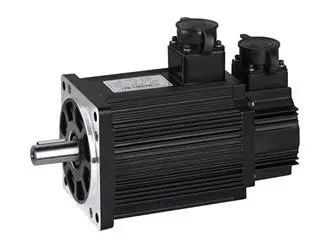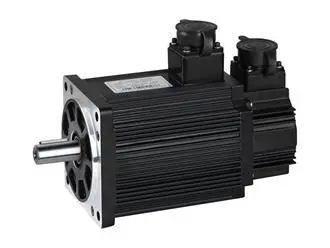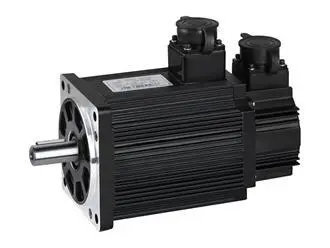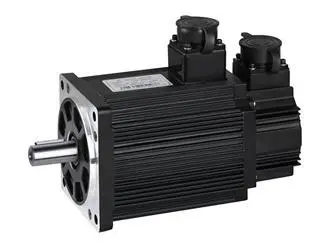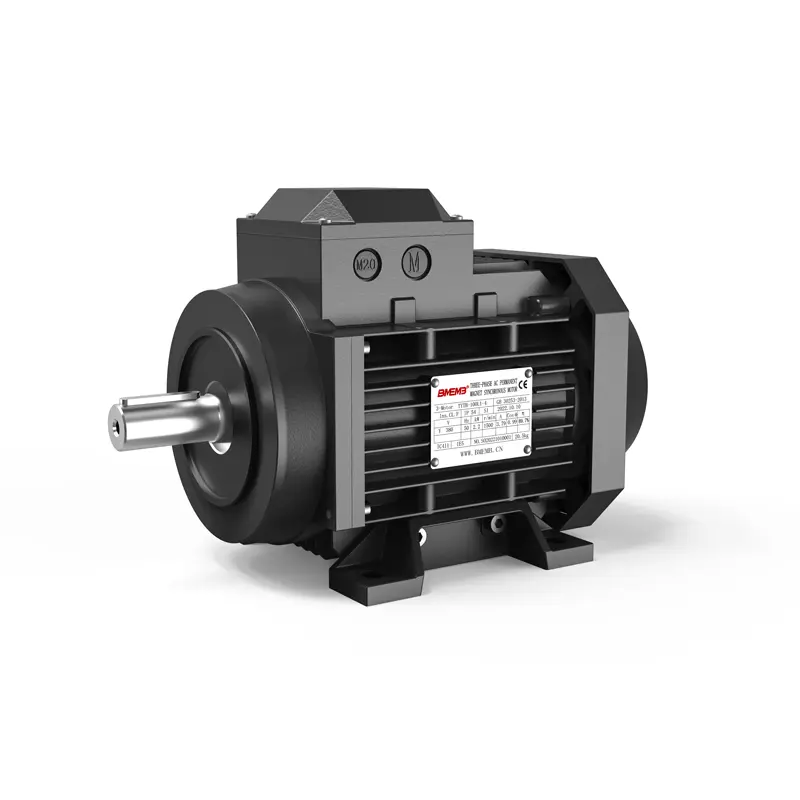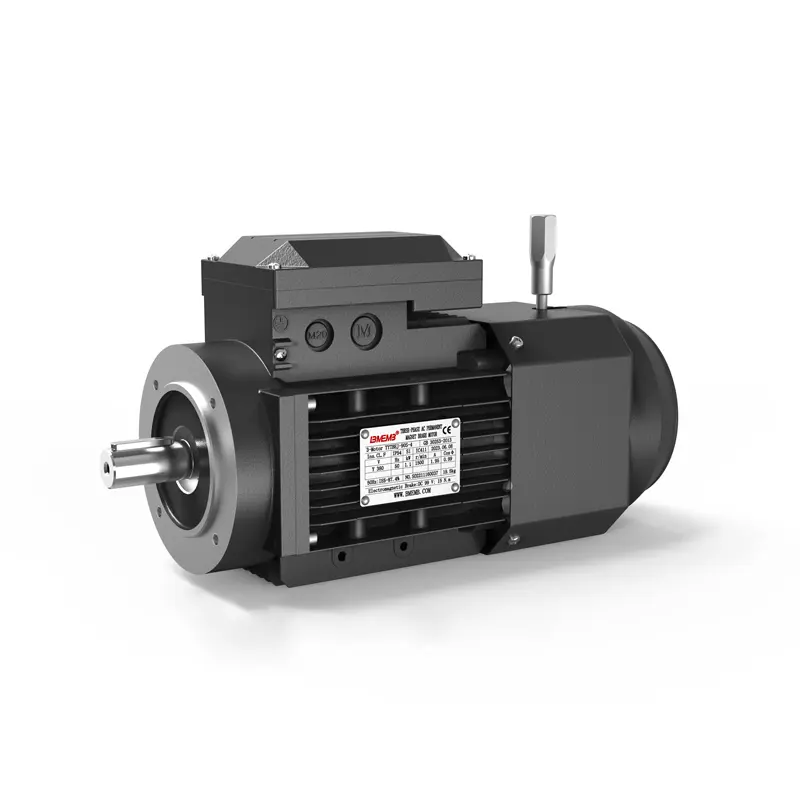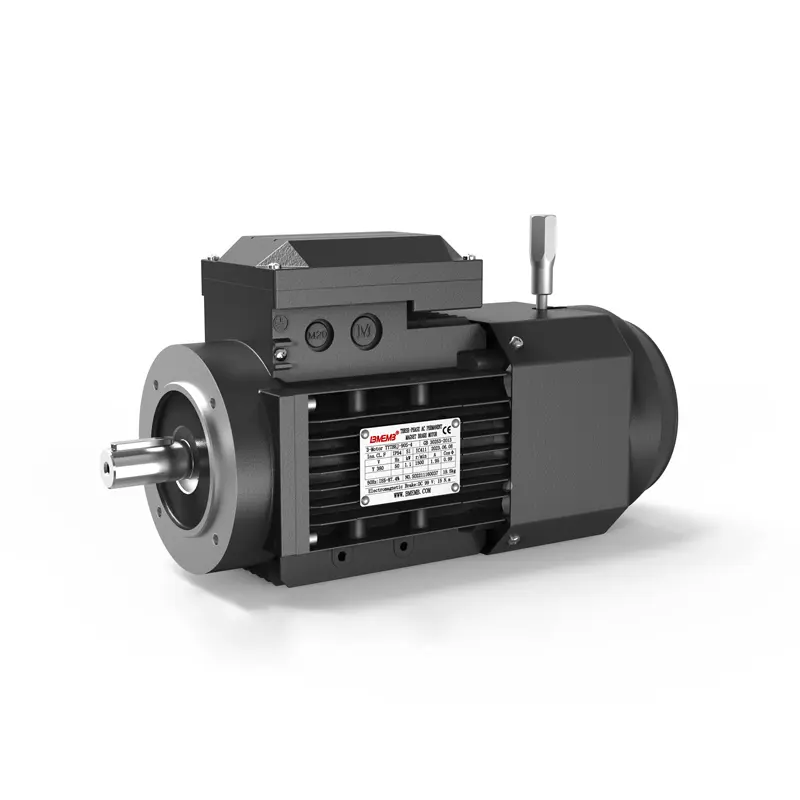
Raydafon TYTBEJ permanent magnet synchronous brake motor combines a rare-earth PMSM rotor with an integrated electromagnetic DC brake on the rear cover. Power range 0.55 to 22 kW, frames 80 to 180 in 2-pole, 4-pole and 6-pole versions. Efficiency in the 25%–100% load range is 8%–20% higher than an ordinary asynchronous motor, energy saving reaches 10%–40%, and power factor increases by 0.08–0.18. The brake is spring-applied, so it engages automatically when the coil loses power and holds the shaft in position. Brake response is about 0.5 s for frame 80, 1 s for frames 90–132 and 2 s for frames 160–180. Protection grade IP55 and insulation class F. Installation dimensions match the TYTB family, so TYTBEJ drops into an existing motor mount. Used on conveyors, hoists, elevators, packaging lines, robot joints, door and gate operators, and woodworking or metalworking machines that need quick stop and position hold. OEM brake supply voltage, shaft dimensions, voltage and frequency available.
TYTBEJ Permanent Magnet Synchronous Brake Motor – IE3+ Efficiency and Fail-Safe Braking in One Frame
TYTBEJ combines a permanent magnet synchronous motor with an integrated electromagnetic DC brake on the rear cover. The rotor uses rare-earth permanent magnets, so efficiency in the 25%–100% load range is 8–20% higher than an ordinary three-phase asynchronous motor, energy saving reaches 10%–40%, and power factor increases by 0.08–0.18. When power is cut, the brake spring presses the friction disc onto the rear end cover and the shaft stops; when power is restored, the excitation coil pulls the pressure plate back and the motor runs normally. Installation dimensions match the TYTB family, so the unit drops into an existing motor mount without re-machining. Frames 80 to 180 cover 0.55–22 kW in 2P, 4P and 6P versions.
0.55–22 kWPower range
8% – 20%Higher efficiency than asynchronous
0.5 – 2 sBrake response by frame
IP55 / FProtection & insulation
01 · Timeline
How the Fail-Safe Brake Works, Step by Step
The brake is fail-safe: it engages when the motor loses power. This is what makes the TYTBEJ suitable for hoists, inclines and other axes that must hold position after a stop signal or a power failure.
Step 01
Motor Energized
The excitation coil receives power and generates electromagnetic attraction. The spring pressure plate is pulled back, releasing the friction disc so the shaft can rotate normally.
Step 02
Power Cut or Stop Signal
The coil loses power. The brake spring pushes the pressure plate against the friction disc, which presses onto the rear end cover of the motor.
Step 03
Friction Torque Builds
The brake disc uses a wear-resistant friction material. Friction torque builds quickly and holds the shaft against the load, even on vertical or inclined axes.
Step 04
Shaft Stops
The shaft stops within the braking time for its frame size. When power is restored, the cycle restarts from Step 01 automatically.
The TYTBEJ rotor uses rare-earth permanent magnets. This removes rotor copper loss and slip, which is where a standard asynchronous motor loses most of its energy.
This product
TYTBEJ PMSM with Brake
RotorRare-earth permanent magnet
Efficiency vs async+8% to +20%
Energy saving10% to 40%
Power factor increase+0.08 to +0.18
Overload capacityAbove 2.5× rated
Integrated brakeFail-safe electromagnetic
Comparison
Standard Asynchronous Motor
RotorCopper or aluminium bars
EfficiencyBaseline
Energy savingBaseline
Power factorBaseline
Overload capacityLower on low speed
BrakeRequires external brake
Efficiency gain
8% – 20%
Energy saving
10% – 40%
Power factor gain
+0.08 – +0.18
Overload
Above 2.5×
03 · Models
Frame Range and Pole Configurations
Frames 80 to 180 cover 0.55–22 kW in 2P, 4P and 6P. Installation dimensions match the TYTB family, so TYTBEJ drops into an existing motor mount without re-machining the frame.
2P≈ 2900 rpm
TYTBEJ-80120.75 kW
TYTBEJ-80221.1 kW
TYTBEJ-90S21.5 kW
TYTBEJ-90L22.2 kW
TYTBEJ-100L23 kW
TYTBEJ-112M24 kW
TYTBEJ-132S1-25.5 kW
TYTBEJ-132S2-27.5 kW
TYTBEJ-160M1-211 kW
TYTBEJ-160M2-215 kW
TYTBEJ-160L-218.5 kW
TYTBEJ-180M-222 kW
4P≈ 1450 rpm
TYTBEJ-80140.55 kW
TYTBEJ-80240.75 kW
TYTBEJ-90S41.1 kW
TYTBEJ-90L41.5 kW
TYTBEJ-100L1-42.2 kW
TYTBEJ-100L2-43 kW
TYTBEJ-112M-44 kW
TYTBEJ-132S-45.5 kW
TYTBEJ-132M-47.5 kW
TYTBEJ-160M-411 kW
TYTBEJ-160L-415 kW
TYTBEJ-180M-418.5 kW
TYTBEJ-180L-422 kW
6P≈ 960 rpm
TYTBEJ-90S60.75 kW
TYTBEJ-90L61.1 kW
TYTBEJ-100L-61.5 kW
TYTBEJ-112M-62.2 kW
TYTBEJ-132S-63 kW
TYTBEJ-132M1-64 kW
TYTBEJ-132M2-65.5 kW
TYTBEJ-160M-67.5 kW
TYTBEJ-160L-611 kW
TYTBEJ-180L-615 kW
04 · Brake Timing
Brake Response by Frame Size
The brake response time scales with the rotating mass of the frame. Larger frames carry a larger brake disc and need slightly longer to stop, but they also hold higher torque.
Frame 80
0.5 s
Frame 90 – 132
1 s
Frame 160 – 180
2 s
05 · States
Brake Released vs Brake Engaged
Motor Energized
Brake Released – Shaft Free to Rotate
The excitation coil is powered and generates electromagnetic attraction. The spring pressure plate is pulled away from the friction disc, so the friction disc releases and the shaft can rotate normally under motor drive.
Coil energized
Spring pressure plate pulled back
Friction disc released
Shaft rotates normally
Motor De-energized
Brake Engaged – Shaft Held in Position
The coil loses power and the spring pushes the pressure plate against the friction disc. The friction disc presses onto the rear end cover and holds the shaft, even on vertical or inclined axes, until power is restored.
Coil de-energized
Spring presses the pressure plate
Friction disc locked to rear end cover
Shaft held against the load
06 · Application
Typical Applications
01
Conveyor Systems
Belt and roller conveyors that must stop quickly without coasting, and hold position on an incline.
02
Hoists & Winches
Lifting equipment where the load must be held after the motor is switched off or when power fails.
03
Industrial Robotics
Robot joint drives that need quick stop and position hold between motion cycles.
04
Packaging Machinery
Filling, sealing and labeling axes with frequent start-stop cycles and short cycle times.
05
Elevator & Lift Drives
Elevator and platform lift drives where the fail-safe brake is a safety requirement.
06
Door & Gate Operators
Rolling shutters, sliding gates and barriers that must hold position when power is removed.
07
Woodworking & Metalworking
Saws, grinders and presses that need a fast spindle brake on stop signal.
08
Slow-Speed Precision Axes
Positioning axes that need the motor to hold its position between motion commands.
07 · Quality
Quality Assurance and OEM Customisation
Quality & Testing
ISO 9001:2015 certified quality management from raw material to final assembly. Every TYTBEJ unit is tested for brake engagement torque, insulation resistance, vibration and no-load running before packing.
ISO 9001:2015 certified
100% brake engagement test
Insulation resistance check
Noise and vibration check
Full material traceability
Custom & OEM Options
Custom brake supply voltage
Custom shaft extension and keyway
Non-standard rated voltage 220V, 400V, 415V, 460V
60Hz or dual-frequency designs
Higher IP ratings IP56, IP65
Special paint and nameplate branding
PTC or thermistor thermal protection
08 · FAQ
Frequently Asked Questions
What is the difference between the TYTBEJ brake motor and a standard TYTB PMSM without brake?
Both versions use the same permanent magnet rotor and the same installation dimensions. The TYTBEJ adds an integrated electromagnetic DC brake on the rear cover. When power is cut, the brake spring presses the friction disc onto the rear end cover and holds the shaft; when power is restored, the excitation coil releases the disc and the motor runs normally. Use the TYTBEJ version when the driven machine must hold position or stop quickly; use the standard TYTB version when no brake is needed.
How fast does the TYTBEJ brake engage?
Brake response time depends on the frame size. Frame 80 stops in about 0.5 s, frames 90 to 132 stop in about 1 s, and frames 160 to 180 stop in about 2 s. Larger frames carry a larger brake disc and higher rotating mass, so they take slightly longer to stop but hold higher torque.
Is the brake fail-safe?
Yes. The brake uses a spring-applied design: the spring engages the brake when the coil loses power. If the motor loses power, the brake engages automatically and holds the load in position. This is what makes the TYTBEJ suitable for hoists, lifts, inclines and other axes where a fail-safe brake is a safety requirement.
What is the efficiency of the TYTBEJ compared with an asynchronous motor?
In the 25%–100% load range, the permanent magnet rotor delivers 8%–20% higher efficiency than an ordinary three-phase asynchronous motor of the same power. Energy saving reaches 10%–40%, and power factor increases by 0.08–0.18. Overload capacity exceeds 2.5 times the rated torque. The brake mechanism does not compromise the motor efficiency.
Can the brake supply voltage be customised?
Yes. Standard brake supply voltage and rectified DC voltage depend on the frame size. Custom brake supply voltage and rectified voltage are available on request for OEM projects. Provide the required brake voltage and release time when requesting a quotation.
What is the warranty period and OEM lead time?
We provide an 18-month warranty from shipment date covering manufacturing defects, with full technical support. Standard TYTBEJ models are stocked; custom OEM orders typically ship within 25–35 working days after drawing confirmation.
Send Your TYTBEJ Brake Motor Application Data
Provide required output power, synchronous speed, voltage, frequency, brake supply voltage, stop time requirement and driven machine description. Raydafon will confirm the correct TYTBEJ frame and brake configuration, and reply with a factory-direct quotation within 24 hours.
We are happy to provide a quote for any of our products. Give us a call at 86-574-87167707 or fill out the form below and one of our engineers will be in touch shortly. Please include a product description and any customizations you need.
We use cookies to offer you a better browsing experience, analyze site traffic and personalize content. By using this site, you agree to our use of cookies. Privacy Policy